Showing posts with label television. Show all posts

Wednesday, June 21, 2017

Weeks #2017.22-23 on SébPhilatélie

Ten days in June, before Summer hit the South of France (and the rest of Europe it seems).

Thursday 1st to Sunday 4 June: Interamerican exhibition in Saint-Pierre-and-Miquelon.
During four days, the Club de Saint-Pierre (with a refurbished website) hosted its third international exhibition in this French overseas collectivity, SPM Expo, with six countries of the American continent attending.
The poster of the exhibit designed by Jean-Jacques Oliviéro (official website).
To follow the event the website and its blog were of course useful, and were reinforced by the local radio and television public channel, SPM 1ère.

A list of reports and interviews to watch back:
- Club president Stéphane Fouchard presented the event, the importance of exhibiting and the value of collecting stamps during the radio news on Thursday morning ;
- On the Wednesday evening tv news the mounting of the exhibit was reported ;
- On Friday the camera followed high school students training their Spanish with Jaime Benavides, the Mexican representative (on this link look for the 2 June 2017 edition), followed by Fouchard explaining this was the sole continental competition for 2017 and the impact for the archipelago ;
- On Sunday (article on Monday) a report of the award ceremony took place with the 109th and 110th medal and Grand Prix for Jean-Jacques Tillard and a gold medal for Loïc Detcheverry for Cancellations of Nova Scotia on stamps of Saint-Pierre-et-Miquelon. Jim Taylor, President of The Royal Philatelic Society of Canada was interviewed too.

Sunday 4 June: 50 years of Machin, 10 years of philatelying in English.
A personal article on me and the English language. It dated well before I needing it for philatelic purposes, but since my first subscription to Stamp Magazine, English philatelic reading became quite addictive.
The June 2007 issue of Stamp Magazine that encouraged my continuing subscription.
The Machin series is to thank for too.

Wednesday 7 June: Were chocolate bar wrapping be recess-printed!
Warning: open class topic getting off-topic... but...

After many weeks of thoughts I finally opened and ate the Rococo Chocolates bar I bought last January in Chester (remember). A powerful taste for only 63% dark chocolate from Peru!
Okay, I admit, this item is damaged. I need to learn how to unmint chocolate packaging... Must be like carefully open envelopes.
Back to philately... Let's try at least.

The drawing outside and inside the cardboard wrapper are the same that of the shopping bags and could have been printed in intaglio.

The article was written to mark the day the Rococo Chester team opened its new premises: 118 Northgate.

Friday 9 June: Another souvenir of Frédéric Bazille's paintings.
Thank to Michel Soulié, President of the Montpellier Philatelic Association, I now held a 1980 souvenir edited by the association for the Day of the Stamp, inspired by The Pink Dress, another view of the Castelnau village by impressionist Frédéric Bazille.
Local Montpellier souvenir at the Day of the Stamp 1980, illustrated by G. Jeanjean, inspired by Frédéric Bazille.
Readers in the Americas could see paintings of Montpellier-born Bazille in Washington, D.C. until the 9th of July at the National Gallery of Art.

Sunday 11 June: The Postal Museum to open 28 July in London.
Finally - some almost waited 20 years - the Postal Museum is to open in London on Friday 28 July 2017.

More informations on the Museum's website and Twitter account.

Today, 21 June, there still some informations missing, especially how to book for the Mail Rail, the new attraction reactivating the former London postal underground train of the British Post Office.


After such ten days, Spring felt very well, the Winter children thought... But Summer was coming.

Wednesday, June 14, 2017

French villages got talent... and a stamp

On Tuesday 13 June 2017, Rochefort-en-Terre hosted the one-night contest Le Village préféré des Français on France 2, the main public television channel, presented by Stéphane Bern, our current perfect son-in-law and expert on European royalty.
Very rare event in France nowadays: a new stamp announced on prime time tv (ok, not the best audience of the night facing an international football match) and in a knowledgeable way: the picture shown is the engraved one, not the computer before gravure one (France 2, catched and captured thank to Dominique Stephan of the Blog philatélie, an important blog for amateur of France from the Sower to current events).
The village in Morbihan, Brittany, won the 2016 edition of the show created in 2012 and broadcasted live in June. A sort of Let's spend the holidays in our homeland. I have been told of many past participating villages by weekenders, hikers and... of course: stamps.

For a long time now the French post has a tradition of issuing "touristic stamps" on cities, villages, regions, natural parks, islands,... And whatever techniques the artists and the printer used, the result is often far better and enjoyable than the other main category: anniversaries of personalities and institutions that can be very logo-only or with not enough hints of why they are commemorated.

Sometimes the smaller the place, the bolder the artist or the printer: multicolor intaglio printing are common in France, but not often with such stricking color as bright red on quieter colors. Other examples can be found (browse Phil-Ouest.com database or your Dallay/Spink catalogue) with seldom colors such as brown, violet and dark orange together for village close to mountainous cliffs.

Artists' side: you can find modern-style illustration like the summer beach of Saint-Brévin-Les Pins last year, or use of the sky and clouds to place symbolic elements of a city.
The illustration project by Elsa Catelin before engraving (via Blog Philatélie). It's the form generally presented by Phil@poste in its catalogues and publications.
During the 2017 edition of the tv show, the stamp for Rochefort-sur-Terre was presented in exclusivity. The stamp was added at the last moment (officially in May) in the philatelic program and its illustration hidden until tuesday night.

Enthusiastically (his normal behavior) Stéphane Bern showed the inside of a file to the camera: a complete sheet of the new stamp alongside the engraved one-page souvenir Phil@poste edits with each issue. He insisted enough on the artist Elsa Catelin, one of La Poste's in-house engravers.
First day cancel in Rochefort-en-Terre (La Poste Bretagne's Twitter account)
And the announcement: the first of day of sale for the morrow - Wednesday 14 - in Rochefort and Carré d'Encre, Phil@poste's shop in Paris, and the general sale on Thursday.

This show can be watched again for 30 days (but because of TV tax that may be not possible outside France): over here. The stamp announcement was cut and posted on youTube over here.

For a more negative article on the new stamps on France: read this other article in French on SébPhilatélie.

Note added Thursday 24 August 2017:
This televised event displeased the editor of L'Écho de la timbrologie, one of the three French philatelic monthly magazines, because of the embargo on the stamp and all intelligence about its issue, place of first day of cancel, etc. La Poste is accused of hiding news from the usual stamp collectors.

Until now I was only aware of British dealers being unable of preparing first day cachet for "secret issue", that Royal Mail hadn't even told them the topic. And when their amateur competition on auction websites displaying stamps to be issued ,which appearance was under embargo until media launch.

Rest the question: How did these media launch attract non collectors to stamps?

Saturday, May 27, 2017

Week #2017.19 to 21 on SébPhilately and French television

Only five articles in three weeks?!

When we say that French people are lazy with all the May's Banking holidays while the summer sun's arriving too: Labour Day, Victory Day, Ascension, and soon Pentecost... For the latter two: yes, we boast ourselves of being a secular republic.

Thursday 11 May: Micro-Philippinian vs Macro-Russian stamps.
Two postcards, two very different stamps.
A stamp and a cancel very haphazardly made... But efficient and cost saving. Thank you Pascale for the postcard from Bohol island.
Size: 2.5 x 2.2 cm for PhilPost 2015 issue on its Mailing Center picturing the Central Post Office of the capital Manila. Even if the composition is a superposition of... unequal text, picture and logo. The cancel of the Tourist Center is not traditionall round, but very horizontal too.
Large 1997 painting of the "Russian" monastery in Mount Athos, autonomous orthodox enclave in Northern Greece. Thanl you Olga via Postcrossing.
The complete contrary to this large painting, gold shining, round and neatly cancelled 5 cm square stamp from Russia.

Dmitri Anatolyevich Belyukin, one of current institutional painter of the Federation, painted Saint Panteleimon, a monastery founded originally by monks from Russian plains in the 11th century. The printer did a very good job with these bright colors.

Saturday 13 May: Free French postal history in London.
In April the Stuart Rossiter Trust, a British foundation encouraging postal history research, published The Free French in London 1940-1945 by Peter A. Baker.
The announcing flyer.

In a 64 illustrated book, the author studies the mail from the forces, administrations and government gathered around Charles de Gaulle between 1940 and 1945.

9.50 British pounds plus postage.

If you are interested in postal history of the military and French episodes such as the French-Prussian War of 1870-1871, check the publications by or helped by the Trust.

Wednesday 17 May: 4 Android video games for Finlandia 2017.
The main page of the project: http://16tiko.projects.tamk.fi/en/
In the months before European philatelic exhibition Finlandia 2017, the museums of Tampere and the Tampere University of Applied Science worked together on a project for business information students: they had to create video games inspired by the museums.

The 25 games created can be downloaded and played on smartphones and tablets running with Android. On Google's Play Store look for the titles and help yourself with the icons.

Four of them are inspired by the Posti Museo, the Finnish postal museum opened Septembre 2014.
The postal and philatelic games' icons (site of the projet).
Two of them are "scrollers": you have to move the main character or boat on the screen to avoid obstacles and retrieve flying letters in Finnish landscapes and coasts (Postal History by NoClueGames) and mail barrels lost at sea (Castaway by North Star).

Again in Stampedu by Placeholdr Software (for stamp stampede), the player must follow the rythm of the game: letters of different rates are descending quicker and quicker. Would you succeed to frank them correctly while avoiding dangerous fuming black ones. Your reward: stamps!!! At least digitised ones by topics.

World of Stamps by Team Vasama will certainly interest elder collectors: quiz on countries and topics of stamps with stamps to collect as prizes.

An interesting initiative.

Monday 22 May: A philatelic counter in Luang Prabang, Laos.
Without being hopeful, a traveller friend of mine discovered that Luang Prabang has a philatelic counter for 55'000 inhabitants!
A philatelic counter in central Laos in French! A little sign in English will help the majority of tourists still writing postcards (with Tomath's autorisation).
Okay, the city and surroundings are touristic, with I am told fabulous falls and river beaches, including places worthy of a former royal capital.

Stamps bought there seem to spread from 2010 to 2015, Buddhist inspired as much as the 40th anniversary of the National Day with all the symbols of a communist people's régime.

Saturday 27 May: "Suomi! Finland in my heart... Forever!"
This week took place Finlandia 2017, an European exhibition, in Tampere where the Finnish postal museum was opened in September 2014 - remember: it opened with a correspondence exhibit that permitted a media frenzy minisheet.

Not able to attend, I summarize what stamp issues marked this event organised along the year of the centenary of Finland's independence.

Saturday 27 May p.m.: The many problems of first and last kilometers of transportation.
On Saturday early afternoon French public channel France 2 proposed an economic weekly magazine, Tout compte fait, on the transportation of food, mail and goods nowadays.

It summarizes with efficience how the city delivery by bike works (or not considering health and working insurance), how La Poste put its postmen at new tasks to find new revenue (delivering medicine, watching on city problems, visiting elderly), and how barges on river can help deliver goods and food in the country and inside the city.

The reports can be watched again at this address for a week after broadcast. But it may appear on the magazine's youTube page afterwards.

Sunday, January 08, 2017

Week #2017.01 on SébPhilatélie

Tuesday 3 January: The usefulness of IT in philately.
On Wednesday 12 October 2016, Mark Bailey and Mark Copley presented how useful information technology can be for philatelist and collectors during the Crawford Seminar at the Royal Philatelic Society London home.

How to perfectly scan, work the image or manage the different color systems depending if you need to publish on a website or to print a book. And how to prepare a conference powerpoint or an e-book. An interesting lesson.

The powerpoint can be dowloaded on the RPSL website.

Saturday 7 December: A site for Soviet postcards.
Nice find: Soviet Postcards by Kathya proposed pictures of postcard, some illustrated stationeries and other little collectibles created during the time of the Soviet Union.
Seasonal postcard between New Year, winter landscape and industrial growth of the Soviet Union. Not very sustainable, but smily (Soviet Postcards).
Sunday 8 December: In Saint-Pierre and Miquelon, the mail will pass "if Canada allows".
Again, part of the Christmas mail and parcels for the French North American oversea collectivity was detained in Toronto, Canada. 2.2 tons this year. And it wasn't "if weather permits".

It all arrived finally on Monday 2 January morning: the last Christmas gifts and the letters for a national professional election. But, now the mail destined to Metropolitan France has to snail through Halifax and Toronto...

Saint-Pierre's postmaster assured the viewers of local channel La 1ère that, this year, the recrimination was sent high enough so that this kind of episode should not happen again in 2017.

Thursday, December 29, 2016

French geopolitician Jean-Christophe Victor passed away

Yesterday, Wednesday 28 DecemberJean-Christophe Victor died at too young an age for a knowledge passer with his geopolitical television show Le Dessous des cartes (Underneath the cards/maps).
A planisphere with a political message to analyze, what other picture? (Libray and Archives Canada).
On the French-German channel Arte, every Saturday, he described and explained what is at stake in our world through maps of all scales for a quarter century. In parallel, he created with Virginie Raisson a private laboratory to teach and work on these problems with firms and public powers.

His biography reminds his actions and experience in Afghanistan late 1970s and during the 1980s, a diplomat as a cultural attaché and a humanitarian as a cofounder of Action Against Hunger.

These two aspects of his life can be linked to his parents: polar explorer Paul-Émile Victor and television journalist Éliane Victor.

Monday, December 19, 2016

Week #2016.50 on SébPhilatélie

Monday 12 December: demonetisation and new notes in high inflation Venezuela.
In his Sunday 11th show, Venezuelan President Nicolas Maduro announced the demonetisation of the 100 bolivar notes by the next Thursday. In the current inflation inhabitants need "bricks" of these notes to buy the low number of things available, mostly imported.


The 100 bolivar note picturing Simon Bolivar in its 2007 version when three zeroes were cut off (Bank Note Museum).
Maduro and his predecessor Chavez are well known for creating shows... This rushed demonetisation is one of them: while he accused foreign mafias in Colombia to possess lots of these notes, the Central Bank of Venezuela had already announced early this month the printing of new notes from 500 to 20'000 bolivars. Two new coins to be introduced for the former note values.

But, on Thursday the people discovered the new notes weren't there... After two days of demonstrations, looting and illegal border crossing to Colombia to buy goods and food, Maduro reported the demonetisation until January 2nd, blaiming the sabotage of the operation by foreign powers.

If you still believe him, 80% of all 100 bolivar notes have been retrieved by banks... If the new notes aren't there, how is the Venezuelian daily economy working today?

Tuesday 13 December: Demonetisation in India: as many printed as police seized?
Believing The Times of India police and fiscal departments are catching a lot of dishonest people who can't prove how they earned kilograms of precious metal, lakhs and crores of olf and new notes.

And here is the problem for the Supreme Court of India and some politicians: how can thiefs get as many brand new banknotes while the Reserve Bank's printers can't allow one billion common people get their hands on them???

Not a problem for the current government that believed in digitisation of payments from now on.

Saturday 17 December: Can Mayotte become a French département?
A documentary broadcast Sunday 11 on France Ô asked the question: can Mayotte, the little Comorian archipelago who wished to continue to be French, manage to apply all French laws like any other département?
Kalathoumi Bacar, a postwoman, has driven the roads of Chiconi and delivering mail for the past 35 years despite uncertain identities of the destinees and no street names (Zed Production for France Ô).
As an introduction to civil registry and cadastre problems, Séline Soula and Romain Fleury for Zed Production followed Kalathoumi Bacar, a postwomen with 35 year of service. A La Poste's yellow veil under her quad helmet, she drives and walks all king of roads and streets in Chiconi.

Every day she tries to find to whom deliver mail when people have two identities, a traditional built name and a French built administrative one since 2000-2010. No speaking about the slow movement of creating streets names and enforcing their use on mail.

Sunday 18 December: three philatelic reports on Saint-Pierre and Miquelon tv and radio this Autumn.
The local public station Saint-Pierre et Miquelon 1ère continued to follow every step of the philatelic activities in the French overseas collectivity.

This finishing Autumn: the SPM stamps at Paris stamp show early November, philatelist Jean-Jacques Tillard back from Taipei with a new Large Gold medal with a new collection, and a seasonal report at the Saint-Pierre post office where Christmas parcels are back in tons.

Sunday, November 20, 2016

Week #2016.46 on SébPhilatélie

Monday 14 November: 1960-1980 Finland summarised with 4 stamps.
A gift of a Finnish Postcrosser: 4 stamps that show the traditions, economy and international life of Finland between 1960 and 1980.

Tuesday 15 November: Indian banknotes demonetisation aftershocks.
A new page to lighten the first article on the sudden demonetisation of the 500 and 1000 rupee notes in India. From the political fights to the long waiting lines, forgetting the effects to farmers, but not to smugglers of false money from neighbouring countries.
Th 5000 rupee note of Pakistan (via Daily Pakistan).

During the week even the Pakistanese minister of finance had to insist he was not preparing to remove the 5000 rupee note by surprise.

Today some quietness (but in the rural regions) because bank branches were opened only for usual operations and the banknote exchange of their elder clients.

Wednesday 16 November: an introduction to British stamps and philately on BBC Four.
On Monday night BBC Four broadcasted a Timeshift documentary on How Britain Get Stuk on Stamps (available for a month for UK residents).
The presentation of the documentary on the BBC Four website.
A very nice show if you believe the British philatelists' comments on the Stamp Boards forum.

Thursday 17 November: A video game stamp from Lithuania... Heraldic sorry.
On another Postcrossing card, I almost misundersood a stamp:
Thanks to Igor via Postcrossing.
A videogamer would say it's Link on Epona. In fact it's one of the 2016 definitive stamps of Lithuania on ancient depiction of the Vitys, the country's coat of arms.

Saturday 18 November: Netherlands stamps of 2016.
After a jury elected a Grand Prix of Philatelic Art for the Netherlands - guest of the Paris Autumn Stampshow earlier this month, I get into the PostNL philatelic shop of PostNL to give my own awards (and do some comment on how PostNL issued so many stamps... minisheets).
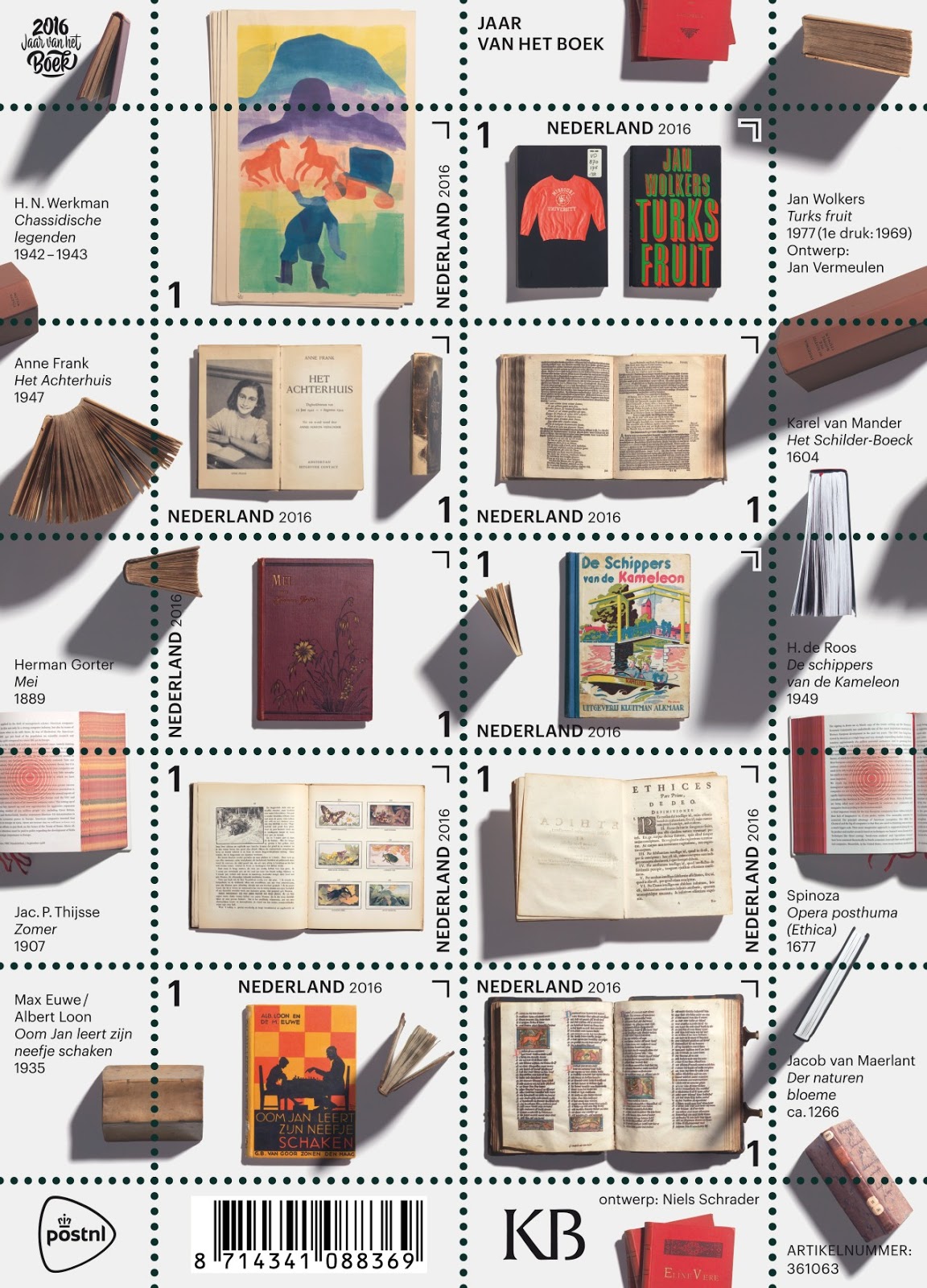
Personal award NL2016: Dutch literature (Collect Club, PostNL).
As the jury liked the photographic lesson on how to picture everchanging blue circles, I like this lesson on how to photograph books from many directions.
Touristic award (among so many issues, including the flurorescent eye-killing ones): fishing villages (CollectClub, PostNL).

Fun award for the Children Stamps illustrated the characters by Fiep Westendorp (CollectClub, PostNL).
Sunday 20 Novembre: Fun with the Kalevala with modern artist.
An article linked to my Don Rosa-Kalevala open class collection, soon to be translated on this blog in English.

Sunday, October 30, 2016

Week #2016.43 on SébPhilatélie and the newsstands

Wednesday 26 October: Stamp artists and philatelic design in Stamp Magazine.
In the British monthly a piece of news, a letter from a reader and two articles encourage the readers to reflect on the role of stamp artists and designers.

In the news: in September PostNord, Danmark and Swede's postal operators, announced its whole philatelic programs will be printed by Cartor, the French subsidiaries of International Security Printers (Walsall a reincarnation ago). The fear is about both countries' tradition of philatelic engraved printing while Cartor doesn't have the equipment... Future will tell.
« Absolute purity of function and form » for Blair Thomson and the end of many debate to the number of stamp issues in the world (British training stamp used before the 1971 decimalisation ; from commons.wikimedia.org).
In the mail a reader reminds Royal Mail and Stamp Magazine that the credits of current British stamps are too often given only to the graphic agency, and not enough to the eventual artist chosen by this agency. He gives the example of the striking Great Fire of London stamps and presentation packs, dranw by Liverpool-born comics artist John Higgins.

Two articles rewarded creators for their part of the work. Peter Marren told the genesis of the 1966 Battle of Hastings issue and how Harrison and Sons printers and David Gentleman transposed the Tapistry of Bayeux into stamps.

Then, along the publication of their book, Graphic Stamps, by Unit Editions, designers and stamp collectors Iain Follett and Blair Thomson picked the ten best and effective stamp designs from the 1960s to the 1980s. You can learn more on Thomson by this interview for the Australia Post philatelic service and Graphilately, his Instagram picture account of his collection.

Wednesday 26 October: New Timbres Magazine 2016 formula sailing full ahead.
In France, after a first new setting in September 2015, monthly Timbres Magazine is now sailing full ahead to a course wished by the majority of its readers, hence the new motto "New formula / more current".

The collectors of France and its colonies are sure to find organised philatelic news, many articles, end-of-the-mag chronicles on all specialities and times of French philately. The rest of the world and topical philately are not forgotten while fitting a different number of articles and spaces (partly in the chronicles and sent questions on mysterious foreign stamps).

A final note on the diversity of writers and chroniclers, that allows every reader find interest in something unexpected. For a personal example, most technical articles on classical traditional philately elude me completely. But a new series of chronicles caught me off guard with philatelists explaining how they research into a mystery whereas making sure the traditional collectors get the knowledge they wish for to look for the possible rarity in their stamps. 

To worldwide collectors of France and colonial empire, why not learn French reading this monthly? Subscriptions are available on the editor's webshop.

Tables of content of past issues can be browse through this private website managed by a philatelic bibliophile (Timbropresse edited three indexes every fifty issues too).

Thursday 27 October: numismatic souvenirs in the museum shops of London.
In the shops of the Imperial War Museum (near Waterloo station) and the British Museum of London, I found souvenirs from Westair, a company who produced reproduction of ancient artefact or souvenirs around actual coins.
A symbolic front to catch the consumer's attention (Westair).
By visiting many museums I think you can recreate a complete World War 2 coin set. Each coin paired with a square of hardback paper describing one aspect of the British daily life during the war.

At the British Museum shop two larget set were available. A five penny collection, one per monarch since Queen Victoria. And the one pictured above: a predecimal set under Queen Elizabeth II with a decimal Crown (normally the 1977 Silver Jubilee one, but I got the 1972 Silver Wedding and that's fine too).

Of course, at the reasonable price proposed, the coins are used, down to smoothed out Queen Victoria penny. Though when you didn't plan to make a tour of high street coin dealers, it's part of the trip fun :)

Saturday 29 October: television fun with the British Royal Family (alleged) life.
A non philatelic article on two television series setting in the life of either the actual Queen Elizabeth, or a very fictional, tv reality style, Hamlet murderously inspired British monarchy.
Will the heroin succeed in her hereditary role? Will her people know six decades of happiness? Will we see Tony Benn displaying David Gentleman headless stamp projects at the feet of the Queen? Don't know what I am dreaming about: read this book by Douglas Muir urgently (Netflix, screen capture from Behind Closed Doors video, posted 11 April 2016 on youTube).
On Friday November 4th, watch when you want Netflix will issue the ten one-hour episodes of the first season of The Crown, the first part of its biography of the current British monarch. All teasers are depicting many conflicts:  loss of the fatherduty and an embarrassing uncle, the Crown versus the Government, an old style husband facing a new position, a sister in love, and anything that can help Peter Morgan and his team create suspense and force you into binge watching.

The next month, December 4th, will start in the United States on E! the third season of The Royals by Mark Schwahn, a quite different animal. Imagine Shakespeare's Hamlet be played with the will to launch a civil war between a young unprepared heir, a power hungry queen mother and a treacherous uncle... while the sister of the heir and the daughters of uncle are... doing what some stars do that they ought not to do when your life is followed by an hungry crowd of paparazzi.
The royal couple in front of the 90th birthday stamp issue at Windsor's Queen Elizabeth mail centre, on Wednesday 20 April 2016 (picture published in South African newspaper The Citizen).
In comparison the current state of the Windsors and their problems (Does William work enough? Shouldn't Charles stop writing to the government? What other places could be named "Queen Elizabeth"?) and even the past ones are quite uneventful.

Monday, October 24, 2016

Week #2016.42 on SébPhilatélie

A week of pause and, well, unphilatelic leisures. Consequently only 3 posts and article this past week.

Monday 17 October: Collectors Club reminds me there is that book in my library.
A recent conference at the Collectors Club of New York, October 5th, reminded me that Gary W. Granzow's book on security printing through the Perkins-Bacon example, is still to be read, years after its purchase.
Granzow's book, published by the Royal Philatelic Society London.
The company was founded by U.S. inventor Jacob Perkins (1766-1849), who emigrated to England in 1819, and his then associate, British engraver Charles Heath (1785-1848). The latter was very interested in the security engraving machines imagined by the former to created unfalsified banknotes. Joshua Butters Bacon, Perkins' son-in-law, bought Health's shares in 1829.

The conference is didactic and illustrated with the designs from Perkins' patents and for a good reason... During the Q&A, Granzow explained that only Perkins and his closest partners were capable of conceiving, building and maintining the engraving and printing machines!

Perkins-Bacon went bankrupt in 1935 hit by competititve new technics and ill-management. The Royal Philatelic Society London acquired its archives (search the catalogue), that helped the writing of Granzow's Line Engraved Security Printing published 2012.

The 5 October conference can be read on pdf and watch on Vimeo.

Thursday 20 October: A workplace crisis at La Poste? Or in Welfare-State Europe?
The text is my personal insight on the accumulated little incidents at the French public postal operator and to autoemployed parcel delivery workforce in France (some paid - and fined - by La Poste's private subisidiaries). A workforce rebelling in Britain with the support - shocking - of the current conservative government!

My final question is: Can't we find a way to keep the welfare state and not depreciate the economic, social and environmental value of the mail and parcel delivery sector? Or are we, Europeans, doomed to "thatcherize" our whole societies for the sole benefits of the 1% and their minions?

To readers from the United States: yes, I'm French, two steps from marxism :)

Sunday 23 October: Indian Summers and the apex of a crumbling empire.
On Arte, French and German viewers discovered British Channel 4 TV series Indian Summers during the month of October. Two seasons were produced and broadcasted in 2015 and 2016 in Britain.
British DVD edition of the first season  (amazon.co.uk).
Set in the summer capital Simla in 1932 for the first one and 1935 for the second, the series follows a large group representing all kind of situations and behiavors in the British Raj, from the young promising colonial Administrator to the representative of the Dalit who tried to get rights for this cast while pursuing the wish for India's independence.

Amateurs of sopa operas will get their lots of private secrets behind the historical context, all masterminded by the owner of the British club.

Sunday, September 11, 2016

Week #2016.36 on SébPhilatélie

Experts, a lot of books and a tv series... with a look back to the mid-2000s.

Sunday 4 September: Expertise offensive in France, still going.
For almost a year now, associate experts Calves son and Jacquart are continuing expending their presence after they open their expertise certificate index on the web that allow to check a certificate a buyer or an exhibition judge wish to control.

This September, they are now publishing a monthly column in Timbres magazine alerting the public with the fraudulent and false stamps, cancellations or overprints they encountered recently.

November 2015, expert master Jean-François Brun, still active but perhaps not into communication as his two competitors, launched a pedagogic blog with pdf file to explain and teach the collectors on the problem of identifying frauds.

In the last article, he highlighted the lightness of stamp catalogue that have refused to print that a 70 cent Paquebot Pasteur can not exist without overprint (its issue was chaotic because of the 1939 declaration of war), allowing the hopeful doubt of having found a rarity... Then he reminds consumers that a dealer should not expertize the material he knows he is going to sell.

Wednesday 7 September: The 1836 Anglo-French Postal Convention by Geoffrey Lewis.
Having read large part of Australian postal historian Geoffrey Lewis' book, I proposed my literary critic - despite being a moron in the field he studied :)
The book cover (Books on philately. The philatelic bilbiopole).
The first chapter is the most important because he graphically explains what one should look at on a 1830s letter that went through the British-French postal road. Both postal administrations then created a mean to be sure that incoming and outgoing mail were going to be paid whatever the origin and destination in the whole world.

And that's why the other chapters are very interesting, even if quite repetitive. Lewis established them by marcophilic and geographic topics. Yes, he repeats a lot the same principles, but you easily find all the intels you need to decipher the marks on that particular letter you are holding.

To see how Geoffrey Lewis works, a pdf summary of one of his conference is available on the American Philatelic Society's Postal History Symposium website. He participated to the 9th edition at the New York Stampshow last May-June.

The book is published by the Royal Philatelic Society London.

Saturday 10 September: Philatelic t-shirt in The West Wing.
Article available in both French and English.
The philatelic collectibles on the heroin's shoulders (The West Wing, 2005).
And I am still interested in any information on who designed this t-shirt, please.

Sunday 11 September: Belgium in the Biblioteca Sebastiana.
Thank to a gift this week, I present the three Belgian books in my small library: the 50th edition of the Official Catalogue of Belgium (2005), Patrick Maselis' 2005 book on the thirteen trials of creating colonies in the whole world from the Azores Islands, known as the Flemish Islands back in the mid-15th century, until the still Belgian inhabitants of Villaguay, Argentina.
Cover of the Englihs and French edition of Vincent Schouberechts' book (the editor website).
2016 new publication I received is Vincent Schouberechts' The Post Books: 500 Years of history in Europe (Lannoo edition). Through the study of fifty documents, he told the larger public possible how the postal system was established, has grown in Europe from the 16th century until the General Union of Post that make international sending of mail easier.

A common line helps organised the book: the birth and death of the postal monopoly of the Thurn und Taxis family in the Holy Empire. On the side, the author proposes trips to the Antiques, Middle Ages and Space mail. Let's hope it attracts new people towards the study and collections of old documents and postal history.

The most attentive of you will remember the special exhibition proposed by the Club of Monte Carlo at Europhilex London 2015: 20 documents for 20 events that changed the world. The enjoy this book and the pdf of the exhibit still downloadable.

Saturday, September 10, 2016

Stamps in 'The West Wing' tv series

Ten years ago last May the final episode of The West Wing was broadcasted in the United States. Created by Aaron Sorkin, it tolds the daily work of a fictionous democrat president. It was a pedagogic work to explain the theory and practice of the federal republic... especially as it was on during the adventurous and teapartyist mandates of George Walker Bush.
The White House Chief of Staff alarmed by her Blackberry at the beginning of 365 Days during the 6th season of The West Wing (2005, screen capture of the French DVD edition).
On the philatelic side, I have already written in March 2007 on the episode Galileo of the second season during which political adviser Josh Lyman discovered the selection process of the U.S. philatelic program, with the inequalities between the 50 states and the territories, like Puerto Rico, in the background.

Yesterday evening my eyes were intrigued by the déjà vu feeling from C.J. Cregg's clothes in the 12th episode of the 6th season, 365 Days ; an episode on the blues of the final presidential year.

Squinting my eyes in the second scene with the character (screen capture), the light went up: a black t-shirt with classical postage stamps of Queen Victoria for sure. Perhaps from Edward VII and George V reigns... Even royal effigy and arms of other European monarchies.

Of course such a detail is difficult to check on Google eleven and a half years afterwards: What forums' archives should be explored? Did a philatelic magazine catch it then? How to find the designer from one single piece of cloth?

Help!!!

This article is available in French on SébPhilatélie.

Sunday, September 04, 2016

Week #2016.35 on SébPhilatélie

Monday 29 August: cartophily, philately and genealogy.
French newspaper Le Figaro proposed a reprint of a 1903 article on the novelty in Summer holiday correspondence that pictorial postcards created in the beginning of the 20th century.
Le Tréport, Normandy: the bath (collection Casa-Rodriguez, 2009, creative commons licence; reproduced in LeFigaro.fr, 26 August 2016).
Imagine that only a handful of words was then authorised on the picture side. Instead of an "it was better before" approach, the 1903 journalist appreciated that the holidaymakers could enjoy their summer time instead of writing lengthly letter describing the place and the activities.

I continued with a critic of postcard specialist Serge Zeyons in the September 2016 issue of Timbres magazine. The monthly encountered a printing reform and Zeyons' article suffers of it: the pictures are so tiny. But the text is longer than usual and with a bibliography to extend the topic way further than postcards: life in the farms and country in old time France.

And I wonder: could Timbres create a joint event with a genealogy magazine? The latter and its readers could retrieve the identity of the people on Zeyons' card while the former and its readers could value the card and the stamp... All of them discovering the multiple interest of the postcard collection...

Tuesday 30 August: Saint-Pierre and Miquelon born artist came back for the Summer.
It's a tradition for landscape painter Raphaële Goineau to spend August in her native Saint-Pierre, in the French collectivity in front of Newfoundland, Canada. It's a tradition for the local public television to report of her stay and current activities in Western France and in the archipelago.

Here is the 27 August report on SPM 1ère.
Le Banc bleu, a painting by Raphaële Goineau , stamp issued 2009. A wooden and color touch reminding North American houses (colnect.com).
This year, the journalists reported her new role of artistic consultant for the Saint-Pierre and Miquelon philately since the death of Marc Taraskoff in March 2015. She is seen adapting on her computer a naval drawing by a local artist to adapt it for intaglio printing at Phil@poste Boulazac, the French post printing plant.

Wednesday 31 August: Who said it? or a philatelic parody of the burkini crazyness.
Beware: disrespect towards French Prime Ministers and female body content in the post (since the French males seems obsessed by what women should show on the beach this summer).
The current Marianne of the Youth issued 2013, designed by Olivier Ciappa and David Kawena. Ciappa alleged on the presidential unveiling that she was inspired by Femen activist Inna Shevchenko (first day cancels took place in the city where there was a high school that participated to the Marianne selection).
Who said: "Marianne, she's bare breasted because she feed the people. She doesn't wear a veil because she's free! That's the Republic!" (count: it just enough to be retwitted!)

A: Olivier Ciappa, Republic-inspired, to explain the seem to be bare shoulders and long hair of his design... before the now famous tweet about Inna Shevchenko.

B: Inna Shevchenko herself while demonstrating fully nude in front of the townhall of Nice, to enjoy the stripping on beach policy of security deputy major Christian Estrosi... Just before she was arrested by local policemen because, the conservative being hypocritical, males should only covet female bodies on beaches.

C: Prime Pornograph Dominique de Villepin, then Prime Minister, just before grossly concluding that "France wish to be fucked. It itches in her pelvis". (note: B never happened, C did...).

D: Current Prime Minister and now new Prime Pornograph of the Nation Manuel Valls because his junior collaborators can't read completely and with curiosity the works of Maurice Agulhon, historian of how the Third Republic took root in our nation, and of Pierre Nora, specialist of the Republican symbols and places. University professor Mathilde Larrere tried to educate the "moron" through his own language: tweets.

What about radical imams? Foreign finance of mosque building? Surely more effective yet more dangerous than disturbing mothers with children on beaches or kids not eating pork at school restaurants.

Thursday 1 September: An inspired rentrée at the RPSLondon.
The first trimester of the schoolyear will be well occupied at 41 Devonshire Place, London, between the traditional activities of the Royal Philatelic Society London and the special events the society hosts. The article in French put together news from The London Philatelist dated July-August.

My apologies for the exhibitors and lecturers I won't name. The Weekly is a summary ; they are acknowledged in the French article and will be again in articles commenting their individual event during the season.

On the special event side: the World Cinderella Congress 16-18 September, the same week of Stampex, its dealers and two exhibitions (Cinderella Stamp Club and King George VI Collectors Society) and of the first paper by Keeper Michael Sefi from stamps of Guyana and Barbados in the Royal Philatelic Collection (Thursday 15).

September exhibitions at 41 will continue to show the Francis Kiddle Congress collection and the Cinderellas created by groups of retired and elderly through a partnership between the RPSL and the University of the Third Age (U3A). The Society is looking for a supply of gummed paper and a perforation machine to allow the successful activity to be reproduced outside London.

Thursdays lectures and exhibitis until the beginning of November will present many islands, both actual ones (Barbados, Channel Islands occupied by the German forces, the Victorian fiscal stamps of the West Indies) and philatelic ones (fiscal so, scoutism and scout postal history by Norwegian Hallvard Slettebø).

The two monthly exhibitions will cover other fields: Bahrain postal history in October, classical mail of Great Britain in November.

Those who are curious of new fields and tools for philately will be interested by the two final events of my list. Wednesday 12 October, the Crawford Seminar will educate to "Digital Philately for Beginners". How the computer, its softwares and companions such as the scanner, can enrich the practice, study and collection of stamps and mail (scan, image study), down the stream to how to create an exhibition or spread the knowledge (slideshow, publishing). John Horsey gave a very stricking evidence of that with his monumental study of hundreds of the Queen Victoria 5 pounds (a book, and a RPSL conference October 2015).

Next, Friday 4 November, Chris King, immediate Past President of the RPSL, will give this year Stuart Rossiter Memorial Lecture on "Challenges and Opportunities of Researching Online". In the study case of Napoleonic Danmark, he will show a postal historian can become an actual historian in the social, economic, political subfields.

An approach supported in recent competition with the 2C class of the International Federation of Philately that was recently found in France with Timbres magazine article (May 2015) by Guy Dutau on a 1861 letter from Tahiti to Chile resolved with the technics of genealogy. And how Robert Marion told visitors of his Mauritius postal/social history exhibition the future of the desperatelt ill writer of a letter... That didn't die in Mauritius.

Saturday 3 September: Funny Hong Kong stamps cancelled in Copenhagen.
Bought for fun at the Danish dealer JF-Stamps, last Paris Philex.
The Danish cancel on the Hong Kong stamps (personal collection).
A 6 April 1951 envelope posted by John Manners and Co. Ltd, in Hong Kong and arrived in Copenhagen, Denmark on the 10. But why apply the mark on the stamps while another cover of the same people and almost dates is clearly marked lower.