Friday, November 13, 2015

From Dallay to Spink through zombie Maury, a story of the best catalogue of France

Last May 2015, a British auction house stroke the sky of the French philatelic pond with an unpreviewed announcement: Spink bought the Maury catalogue from the Maury firm of Paris. Last week, at Paris Autumn Show, the first edition of the new "Spink | Maury" catalogue was presented with ten new monographies added.

The Spink | Maury 2016 catalogue that I hope will lose the "Maury" sooner rather than later (philamurat.fr).
Surely the time of Yvert et Tellier being the only known catalogue of France outside France is counted. But where did it begin?

In the recent era some tried to compete against the Yvert supremacy. At the time our story begins, Cérès shop is the only that succeeds to publish one catalogue every year ; all other dealer's book-catalogues disappeared in the 1980s.

The last major try was the Marianne Encyclopedic Catalogue during the 1980s, long regretted as philatelists spoke of it when the Dallay appeared. It was written by Messieurs Brun, Françon and Storch, three important men of the French and European philately[1], and published by Timbropresse, editor of Timbroscopie magazine (Timbres Magazine nowadays).
The first edition of the Dallay catalogue, 2001.
In 2001, at the same time the euro currency becomes a reality in European Union's pockets - but for a little village accross a channel of sea..., two philatelists and computer experts, Luc Dartois and Jean-Bernard Pillet, launched a new catalogue by hearing the wishes of some collectors and dealers: the Dallay catalogue. The name summarizes their names: DArtois-piLLET.

The success was immediate: the new competitor adds a lot of intelligence compared to both his competitors. Explanatory texts, dates of issue, artist's names, quotes a little bit higher than the market but lesser than other publications. The numbering ended in a law battle and in 2004 the Yvert numbers were recognized as Yvert's property. For some editions Dallay bought the right to publish a conversion table to Yvert.

The principalities, colonies and oversea territories catalogues (four in total) received the same encyclopedic treatment and welcome by the public. Yvert and Cérès lowered their price ; the former added a cd-rom to his France catalogue by 2007. A fresh wind was blowing on the frog pond...
The first Maury edition of the France catalogue in two tomes, a huge work never to be republished (flophil84.fr).
But as in every carol, my generation and the older ones know - but the younger knows it thanks to The Disney Channel and dvds - that generally came problems in the disguised form of the witch with a red tasty apple. Yes, my very young youth memory remembers Disney's Snow White rescreening at Christmas in a movie house in Montpellier.

French U.S.-based entrepreneur Armand Rousso was coming back to France to make Philately reach a new era: he bought in 2007 the Dallay and the Cérès catalogues, the Maury store including the rights to its 1864-1880 catalogue's number system that looks like Yvert's... and Lutèce Diffusion, a mail order company specialised in collectibles.

And in 2009, the big read apple looks like a double volume France catalogue fusioning the best of the three catalogues with extensive quotes for stamps on envelopes before 1900. After that, the catalogue came back to one volume, but the event succeeded to put definitively the catalogue in the French philately.

The witch part of the story are only whispered as rumors between people at stamp shows or dealer's shops in Paris... Try a deep search in an U.S. based forum and Google.

Let's see it positively: we get a strong encyclopedic reference catalogue even if we have to support - in the French definition of the verb: endure because we can not avoid it - monthly ads about how important a legend was dead Arthur Maury who created the catalogue you were holding - and not republished since 1880... - and that the French post recognised that genious by issuing him a stamp in 2010 ad libidum... Hence my zombie Maury in the title.


That's why I am very happy that a British Charming Prince - but did not all Disney's Prince speak with an Oxford accent? - is putting some conservative"Glorious Revolution style" seriousness behind the French catalogue and already show with the 2016 additions that it means business.

For now, it seems to my small knowledge that only Stanley Gibbons did something: the France & Colonies (Part 6) catalogue was cut this year, officially to allow collectors to buy only the France part at a lower price.

Will Yvert finally put some encyclopedic in its catalogues? Will there be a translation in English? What will be the content of the Spink France, Colonies and Overseas catalogues in a few years?

And will Spink finally let the name of Maury rest in peace by letting it down? If their catalogue need a two part name: Spink-Dallay's the one!


Notes:
1 : Robert Françon and Jean-François Storch are founding members of the European Academy of Philately. Jean-François Brun RDP, son of a famous dealer, is one of the most important philatelic expert and publisher in France.

One year after (23 November 2016):
Publicly for Yvert (even here), very (too) discreetly for Spink, their 2017 catalogues get a lot of technical both classic and modern philately added if you love all the nuances of pre-1900 stamps or the phosphorescent bands of recent definitives.

Thursday, November 12, 2015

A tribute, two experts and a new catalogue at Paris Autumn Show 2015

Every year, the week-end between All Saints Day and Armistice Day, the French philatelic traders' associations (CNEP) organised the Autumn Stamp Show in Paris, one of the main salons of France along its Spring show and the Federation's national exhibition.

Last week-end, from Thursday 5th and Sunday 8th, the 2015 edition showed philatelic officials and local authorities inaugurate the event, as told by CNEP President François Farcigny.


With his blog Philatélie au quotidien, Journalist Pierre Jullien is your Bottin mondain to the French philatelic world:
- pictures on stamp artists present to meet collectors and sign their stamps and souvenirs : here, there, and here, and will continue to report these artists' activities all year long ;
- pictures of Timbres Magazine redaction with editor-in-chief/documentary director Gauthier Toulemonde signing his travel book and asking philatelic celebs and visitors "what's the stamp that change their collection?" Mr. Toulemonde's videos can be watched again thanks to a youTube page started last Summer. British readers may be interested in the interviews filmed at Spink, London some years ago.

Pierre Jullien emphasized on three major events of this year's show:
- the French philatelic service Director's conference on what his service will do for French philately in 2016 - other than issuing a huge lot of stamps (see this blog last Sunday) ;
- before the show the election by the philatelic celebs of the Grand Prize of the Philatelic Art among stamps of the year of France, with categories for the overseas collectivities and the invited country Canada. Generally quite conservative: intaglio.

And finally the many tributes to illustrator Marc Taraskoff who died last March. Book cover and newspaper illustrator before becoming a stamp artist and the artistic consultant to Saint-Pierre-et-Miquelon philatelic service. His French stamps can be viewed on the Phil-Ouest.com database.


On the visitors side, the webmaster of News du phospho seems to think every year the same drama: at the federal congress complaints on the number of stamps issued, but five months later, forty five minute queuing on chairs made available by Phil@poste (!)  to buy the many new stamps issued especially at the stamp show...

But he reminds readers of the first steps of Spink as a catalogue editor after the British auction house bought the French catalogue Maury-Dallay-Cérès. Like me, he hopes for a brand new mastermind 2017 edition... before a translation in English?


Finally, the French philatelic pond gets to live a cyclic event as two philatelic experts decided to shake the market by launching last October a free option in their expertise: the edition of a free pdf certificate with every expertise they are ordered to do. The idea is that a buyer can consult the database to confirm the stamp and certificate are legitimate.

Messieurs Calves (son of the one who signed) and Jacquart are happy of the nine thousands visitors they get to talk with in four days. Their objective is to make collectors understand the importance and the little cost of expertizing if the whole Philatelic Frog community wants to cleanse the market from false and fraudulent stamps, ignorant or dishonest dealers.

A cycle that needs to be permanent because the last offensive of March 2009: three articles or interviews in Timbres magazine, did not seem successfull enough.

In my humble opinion, I just hope that their activitism might end the expert signature on the back of stamps as a sure way of certifying them... as God writing Commandments on a stone any engraver could wish to improve.

Tuesday, November 10, 2015

Aéropostale pioneers' life reimagined in an alternative history graphic novel

From a SébPhilatélie post in French, Monday September 21st, 2015.

What if the French far right demonstration on February 6th, 1934 got violent enough for the Fourth (Parlementarian) Republic would be overthrown? Britain would get the blame of course :)
Tome 14 cover by Manchu, Oméga, the name of the French fascist movement created by the uchronian authors. To provoke the British, they imagine the French régime would erect a HUGE statue of Joan of Ark by German artist Arno Breker
That's the alternate history - uchronie in French - proposed in three graphic novels by authors Fred Duval, the French graphic uchronist Jean-Pierre Pécau with the assistance of Fred Blanchard.

With three volumes of their anthology series Jour J - D-Day (volumes 14, 18 and 21), they propose the thirties and the Second World War as could have happened if France would have been a fascist régime after 1934, Hitler's Germany was bloodly tamed as soon as the remilitarization of Rhineland and, consequently, the democratic United Kingdom became the main enemy.

All major French politicians, officers, artists and philosophers from our 1930s to 1968 history are reimagined: some as tragic heroes of a dictatorship as they were heroes of the Resistance in our times - especially scientists and airmail pilots ; while others are characterized in an ugly way as the opportunists or the ambitious they were in their young age before becoming wiser men and women intellectuals after World War Two.
Picture of page 4, tome 14 introducing the divergence with Aéropostale's postmarks on cover. The Greek letter Omega being the symbol of the new régime.
And here comes our fictional hero, a pilot of the Aéropostale named Léo Berger, who is lost with his plane and mechanics in the Sahara desert in 1927... saved by fellow pilot Antoine de Saint-Exupéry.

Imaginary postmarks of the French private airmail company, whose pilots pioneered the routes from Europe to the other side of the Southern Atlantic and of the Andes, help the readers go through time until 1942 when Saint-Ex is killed during a personal night flight near the Channel Islands, launching the accusation by Paris against the British government in order to get a cassus belli and finally finish the One Hundred Year war.

Even if Maza, the illustrator, didn't walk on the full postal realism road, it's nice to see that mail and the airmail pioneers still mark the imagination when one imagine the interwar period.

Sunday, November 08, 2015

The week #2015.45 on SébPhilatélie

Let's try to revive my philatelic blog in English by summarizing the main articles of the week on his French counterpart.


Tuesday, November 3rd: postal game night with The Legend of Zelda, a series of Nintendo video games in which the player receives a huge lot of mail since The Wind Waker.

The mail sorting center inside the Island Post Office in The Wind Waker (screen capture of the game by zeldawiki.org).

Because I began playing Twilight Princess these past three weeks, I rediscover the running postman in his bunny underwear... And it reminds me of the mini-game of the previous episode, pictured above: for ruppees and a piece of heart, you can become a postman!
Link and his horse Epona on one of the French 2005 minisheet Heroes of video game (Phil-Ouest.com, THE database to know on French stamps and their creators).
And I was still in philately thanks to this nice low value youth stamp of France. Mario was on the other side at thirty three cents.


Friday, November 6th: revelation from the French philatelic service - Phil@poste -  for 2016.

At the Paris Autumn Stamp Show, Phil@poste's Director Gilles Livchitz presented all the projects of his service to help philately and not just print and sell a huge amount of stamps and souvenirs.

The three hundred post office that will receive a philatelic counter (from the press pdf).
 What of interest for foreign collectors? Philatelic counters are coming back after having being destroyed completely... Three hundred post offices will be affected, where Phil@poste's clients are. Now we have a sort of French philately map.

Or a map of the French stamps subscribers who refused to go full-mail and want to continue going to the post office to get their stamps.
British special cancellation collectors will recognize this item (from the press pdf). 
Don't be surprised if the next first day cover of France arrived enclosed in a paper envelope. Finally, Phil@poste has heard years of collectors' complaints about special cancelled mail being recancelled at the sorting centers. Each envelope will cost fifteen cents.

In the French article, I imagined that an unlucky employee was sent to Assassin's Creed Syndicate's London to find about this easy solution.

Only mischief: the phi greek letter will survive 2015 and continue to disgrace the philatelic program of France...


Saturday November 7th: Belgium philatelic program for 2016 announced.
Picture by Lieve Blancquaert, to be issued on October 14th, 2016 (© bpost).
And bpost succeeded to catch a lot of French speaking web media attention, from the general ones to the religious and communautary oriented ones. The Belgian main postal operator (still majoritary owned by State), communicated on religious tolerance and acceptance with a symbolic stamp uniting a rabbi, an archbishop and an imam.

If you browse the four pdf files of the 2016 program (123 and 4), you'll be impressed by all the serious peoples celebrated from author Verhaeren to ten Belgian Nobel Prizes, a lot of local flowers and André Buzin's birds, the children of the Royal Family, and finally comics character (anniversary of Tintin magazine).

A very nice simple program.


Sunday November 8th: Stephen Colbert entertained TV viewers with banknote collecting.
Colbert proposed you a huge offer for a rare eyepatch (pen inked) Washington bill for only one thousand bucks! (youTube - CBS)
In his Tuesday November 3rd show, U.S. humorist Stephen Colbert entertained viewers of his Late Show on CBS with how one can get lost in the amount of intels when browsing the internet.

But he discovers a website that let people "get rich by collecting money"!

CoolSerialNumbers.com get free publicity and the public a lesson that the serial number of a banknote can improve his collecting value. Of course Colbert went quickly crazy by proposing his own bill collection on sale: don't miss it on youTube.

A cool way of warning the public on how some internet sellers can get their money with awful false collectable, especially the '"Eyepatch Washington" that will remind philatelists on fraudulent cancels and overprints.


A cool week on the leisure side.

Friday, May 23, 2014

French association astonished by 'Origin of the World' stamp buzz

 No such things as bad publicity or only the Finnish can do it.

Late January 2014, a philatelic association of Besançon succeeded to reach French regional, then French national and finally some French speaking countries media with an unissued personalised stamp.

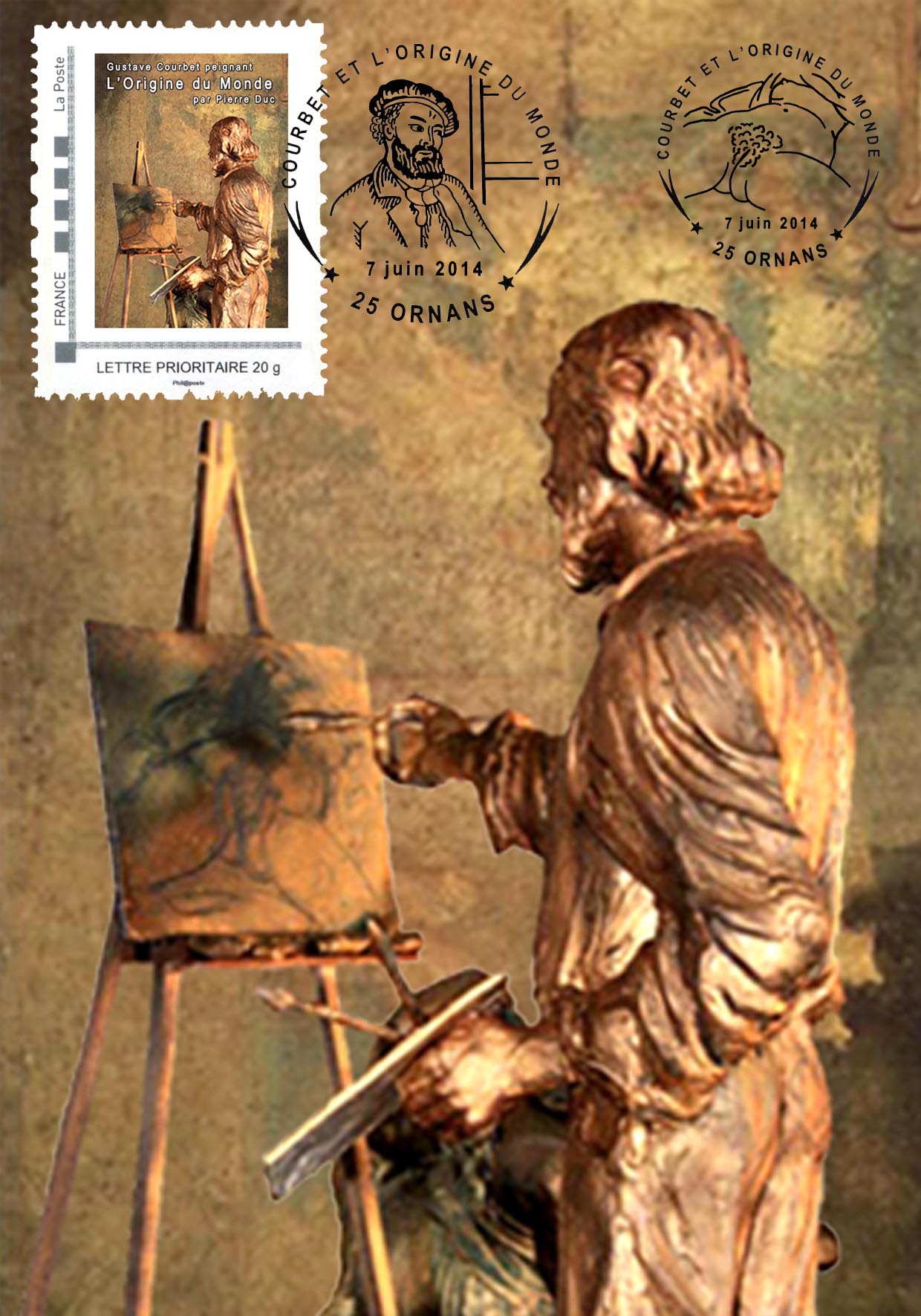
The Philatelic and Cartophile Society of Besançon (SPCB) wanted to mark the opening of a summer exhibition at the Courbet Museum in Ornans by ordering to La Poste a personalised stamp reproducing The Origin of the World by Gustave Courbet. The provocative 1866 painting will be lent to Ornans by the Musée d'Orsay.

The Montimbramoi service refused (with little surprise I thought then) to print something that may shock children. During a meeting in the winter, the Society's members discussed the matter and a solution.

And here the craziness began...

You understand now that the SPCB is active to promote philately and its actions: a local newspaper reported late January this meeting... and then, the buzz began up to conservative newspaper Le Figaro on January 31th. February 10th, on the SPCB website, the webmaster tried to explain the role in the media of what was a small affair after all. This article is largely published in the June issue of Timbres magazine.

This article in Timbres and a May 21st article on the blog present the final personalised stamp: a picture of a bronze statue by Pierre Duc, Gustave Courbet painting 'The Origin of the World' - with the problem slighty reduced in size - with a background made of another Courbet's artwork.

Buzzed but provocative, the Society is surfing on its celebrity: proposing two souvenir postcards with the two proposal artworks, an optional cinderella cancellation of 'The Origin', La Poste will only propose an ordered Courbet effigy datestamp. Finally, the SPCB president hopes that some of the journalists he was forced to meet may come back for other philatelic happenings in Franche-Comté.


Sunday, May 18, 2014

French catastrophe vs British smartness

The bar code is this multifunctional tool created alongside computering and automation during the second half of the twentieth century: sort the mail by address, quickly find the price of a miniature sheet , etc.

But in France, this has created graphical disasters. Little ones: barcode printed inside a blank rectangular in a minisheet corner, but the French philatelic service's President advocated last year they are too thin for the postal counter optic readers. Great ones: put in a blank rectangular ornated with something connected to the stamp topic, thus destroying the topic... Mrs President told that the Belgian Post hadn't find a solution either.


Because the solution was accross the Channel of course, like how to avoid a double strike on a philatelic cancelled item:
Royal Mail placed your item in a plastic bag with all first class necessities, but some may wonder if the commemorative enveloppe can be considered having travelled through the postal system.

Concerning bar code and minisheet, stamp dealer Ian Billings delivered on Tuesday May 15th Royal Mail's explanation. Because Post Office needs bar code for its commercial and accounting, Royal Mail was obliged to add it.

It began with Buckingham Palace interiors minisheet, issued April 15th, and continued with the Greater Post Office Film Unit of May 13th (some movies can be ordered on dvd to The British Postal Museum & Archives).

Instead to force the bar code into the sheet, the philatelic service adds it on the edge, as a white band that can be easily remove thank to a light serration.


Billings and his readers saw too that this margin can only be find on minisheets purchased at the Post Office, and not on those ordered to Royal Mail Tallents House shop. It is explained that the margin is systematically cut off at deliver by Royal Mail employeed "because it is not intended to be part of the collectable product".


A very good idea... but are there not two types of the same minisheet now? What if a new debate without end begin: "Should I collect one with and one without margin?" "Can I buy two at Post Office and cut one myself or is it legit only if a Royal Mail cut off?" and worse if Stanley Gibbons begins to quote the difference.

We will know if this British innovation find the French philatelic pond in June at the next French Associations' Congress and the next interview of the new philatelic service president.

Sunday, May 11, 2014

French moustache fails at Eurovision - Wasn't a Finish one!

Last night, in Copenhagen, Denmark, the French band Twin Twin failed to reach three points and let go the last position of the 2014 Eurovision Song Contest, while Austrian show/wo/man Conchita Wurst catched the enthousiasm of the juries and publics of the whole Europe (but Belarus, Romania, Poland and San Marino).

It's sad for the Frogs because it was a year TV channel France 3 decided to go back to a public voting, mitigated by a jury ; a year when the French song would be moving all over the place.

Was it the song in French? Was it because some large parts of the continent are not ready to acknowledgeskin color is not important?

The three stamp minisheet to be issued in September 2014 at the new Finnish postal museum in Tampere (Itella Posti).
Perhaps the French broadcaster should have taken the Finnish line about moustache: On April 13th, Itella Posti, the Finnish postal operator, announced a commemorative issue for Tom of Finland, a Finnish illustrator specialised in muscular SM males. That explains the stamps: the master dressed as a military, the naked slave and a pair of buttocks.

Official excuse: the inaugural exhibition of the new postal museum in Tampere will be the correspondence of Tom of Finland, starting September 6th, 2014.

Unofficially? Check Google News with / tom of finland stamps / : every news agency in the world know these stamps are going to be issued in four months, time enough to prepare a trip to Tampere, and thus a lot of people will enter a postal museum!!!

Had France 3 and its public chosen a Tom of Finlandesque band...

Thursday, May 08, 2014

'Arabesques', a music festival in Montpellier

The seventh edition of Arabesques in May 2012 was promoted by a booklet illustrated with pictures of musicians, singers and postage stamps.

This music festival is officially named "Meetings of the Arts of the Arabic World" (Rencontres des arts du monde arabe). It is organised by the association Uni'Sons in the park owned by the Departmental Council of Hérault at the Château d'O, a folie in Montpellier.

This 2012 booklet was distributed to promote the festival. It counted forty four square pages, fifteen centimeters wide. There were presented concerts, exhibitions, movies, etc.

Cover of the 2012 Arabesques program.
Inside, the six first double pages about the major night concerts are illustrated with an abundance of pictures and stamps.
Example of "The Three Magnificients" concert of Friday May 25.
Visas from passports, stamps both postal and fiscal cancelled with red or violet inks, on background made of maps of Southern Asia or Spain.

Watch the upper visa from the Iraq Embassy in London. Down and left is a postage stamp from Pakistan marked by a custom stamp explaining this state's rules of entry in English and a rectangular mark of a police station in Barcelona. On the right hand page two cancelled postage stamps from Pakistan:  a fifty paisa and a four anna service stamp.

On these concert pages, all these signs summarize the origins and migrations of the artists. Here Iraqi oud player Naseer Shamma, Pakistani sitarist Ashraf Sharif Khan and Spanish guitarist Niño Josele.


For the 26 of May concert, not illustrated here, the organisers chose the first day cancellation of Tlemcen used for the Fiftieth Anniversary of Emigration Day stamp of Algeria. It illustrated an evening of cabaret music by artists who immigrated in France.

Emir Albelkader.

Other happenings are presented more classically like the exhibition and educated discussion about Emir Abdelkader, both a resistant to French invasion and respected by French military at the time. The black and white reproduction of one of the stamps issued in his honor in Algeria (with the color, it could be either the return of his remains in 1965 or the anniversary of his birth in 1968).

If you miss stamps on your snail mail, don't forget places where the little sticky pieces of paper recalls origins, travels, histories and cultures...

Tuesday, May 06, 2014

Hitler and his philatelic royalties

In an article in Die Zeit, on September 26th, 2013, German historian Volker Ullrich recalled how Adolf Hitler was "the greatest actor in Europe", as the title of the French magazine Books' translation said in February 2014.


At the moment the first volume of his biography of Hitler was published (Die Jahre des Aufstieg 1889-1939), Ullrich explained seven aspects of the Führer's double personality.

Philately is concerned by the seven and last topic, "The multimillionair ascetic", and I hope some researcher found or will find testimonies and archives still available despite the voluntary destructions in the last weeks of the Third Reich.

Sobriety and frugality was the public image, lure of money and a taste for luxury was the reality. With the last new Mercedes cars being offered at once by the builder, voluntary contributions from the biggest German industries given on a private account and the author's rights on Mein Kampf, a 1930s bestseller, Hitler could easily and loudly renounce his chancellor's income in January 1933, to get it back quietly the year after.

In 1937, because postage stamps bore his face, he could be paid "many dozen of millions [of Marks]" as royalties! Ullrich precised that the check was brought each year to Hitler himself by the Minister of Posts Wilhelm Ohnesorge - whose name is ironic too: no worries...

Friday, May 02, 2014

Postcrossing hobby to be stamped by Guernsey Post

Nearly nine year anniversary of Postcrossing will be marked by a stamp by Guernsey Post, on May 28th, 2014.
Created with fun by Bridget Yabsley, it will help the Guernsey Postcrossers to send international postcard from the Channel Island.

Remember: the Postcrossing website helps you find one-postcard penpals: you send them a postcard and consequently you become the next on the list of another fellow Postcrosser.

Forums on the website will help you find long term penpals, round-robin exchanges with people in countries you seldom see the stamps.

Happy Postcrossing!


How can a amateur correspondence website, a little less than 500'000 users in more than 200 countries and autonomous territories, can have its commemorative postage stamps, and not a personalised one?

Thank to lobbying by users, four postal operators have issued stamps:
- PostNL in the Netherlands for two stamps (one for Europe, one Worldwide mail) in 2011,
- Belpochta in Belarus for one stamp [a dictatorship encouraging freedom of correspondence!] in January 2014 ("N" value is for international postcard),
- and now Guernsey Post in May.